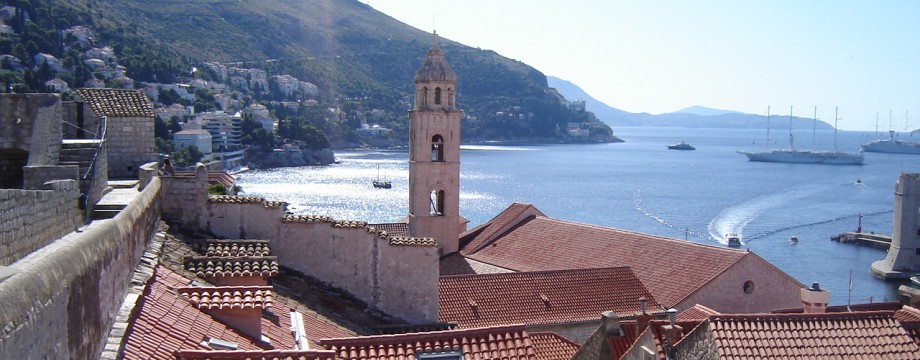

The Gaza Strip, viewed on the horizon from Tel Lachish, Israel, 18 miles away
Several weekends ago, at the close of a pleasant afternoon picking apples with my family on a farm in the Blue Ridge mountains, my daughter transferred an unusual picture frame from the boot of her car to mine. The frame displayed four vintage photographs. My daughter said it was a gift from a mutual friend.
The item was not accompanied by any note, and there were no apparent clues about its purpose or why my friend wanted me to have it in the first place. My wife and daughter thought, “What in the world?” This natural reaction was due to the arrangement of the images. The photos were set to display two nearly identical images side-by-side on its top half and a second grouping of similarly positioned photos of a different scene right below. And they appeared to be pictures of destroyed buildings.
I took a second glance right before buckling up for the drive home. It then became apparent that the images were scenes of ancient ruins located somewhere in the ancient Near East. I immediately worked out that the friend had probably discovered this interesting artifact in an antique shop and kindly gifted it to me because he was aware, though past conversations, of my interest in biblical archaeology.
A third, more detailed examination was definitely required.
* * * * *
For more than a year, I had been laser-focused on events unfolding on a neighboring continent: Europe. Intensely pouring over battlefield reports and independent analyses of the war in Ukraine, I was sharing my own written summaries of developments with others. My interest in the conflict was based upon 25 years living and working in Russia and Ukraine on U.S. government assignments, including two diplomatic tours at the American Embassy in Moscow.
I had been trying to point out how the prevailing narrative about the cause of the war in Ukraine and the chest-beating optimism predicting one side’s assured victory over the other were flawed. I argued that, in order to bring the conflict to a swift end, stem the ongoing catastrophic losses (now well in excess of 500,000 dead and wounded), and save Ukraine from further destruction, the U.S. and its European allies needed a fresh perspective – one that would consider both the underlying cause of the conflict and its potential consequences beyond those being espoused by a single viewpoint. I still believe that a consideration of this overlooked perspective remains essential in order to reach a negotiated settlement – the only way out of the dilemma.
Through my years interacting with both Ukrainian and Russian military counterparts, I learned that early assumptions, particularly those based upon emotion and unjustifiable hostility, if left unchecked, are soon transformed into orthodox conclusions. All progress in negotiations then comes to a standstill – like an armored vehicle stuck in the mud of the Eurasian steppe.
I never felt like the Lone Ranger with respect to my analysis about the war in Ukraine. From the beginning, there were independent specialists in the U.S. and Europe who risked reputations by speaking out. Nevertheless, it has seemed to be an uphill battle getting others to consider this alternative perspective.
Several friends and colleagues supported my arguments. However, many Americans had accepted the prevailing narrative early on. Therefore, it was understandable that most responded with either cautious open-mindedness or charitable silence. A few, who were conditioned to “canceling” any criticism of the official version with hostility and derision, attacked zealously by deploying the mainstream catechism.
I continued to think and pray about the situation – and to consider what more a single individual sitting on the sidelines of U.S. foreign policy might do. It turns out that there is a lot; but it has to begin with prayer.
Then came the sad news about the horrible attack by Hamas on innocent Israeli civilians after the close of “Sukkot” – one of the three pilgrimage holidays celebrated by Jews since ancient times. This week-long “Festival of Tabernacles” commemorates the desert wanderings of the ancient Israelites in the Exodus story, before they entered the “Promised Land.” To this day, many observant Jews around the world celebrate the holiday by erecting booths (tents) and spending time with family and friends in them.
* * * * *
I had visited Israel twice in recent years. During my second visit, I served as a volunteer on a Tel Aviv University-sponsored archaeological expedition at Masada, the last stronghold of Jews resisting Roman legions during the Great Revolt of 66-73 AD.
At one point, Hamas fired several barrages of missiles from their safe haven in the Gaza Strip into southern Israel. Several times, hearing fighter jets climbing upward from the desert floor below, I would put down my trowel, stand up, and watch Israeli Air Force F-16s, as pilots rocked their wings in tribute to this sacred citadel of Masada. The aircraft would then pivot in a tight banking turn to the west and accelerate toward their targets in Gaza.
Several years later, in early October 2023, after learning about the horrifying attack by Hamas – and considering the Israeli determination to wipe out the terrorist organization once-and-for-all – it seemed as though the Middle East was about to explode into a much wider conflict.
Just as first reports from news correspondents were streaming in, my iPhone started to “blow up” figuratively with dozens of messages registering on a previously inactive WhatsApp Chat community of archaeology students and faculty from my time at Masada. Like an old ticker-tape machine, my iPhone seemed to vibrate constantly for several hours signaling dozens of messages – pleas from colleagues around the world searching for information about friends in Tel Aviv and southern Israel, and offering whatever assistance they could provide.
I recalled that several of the Israelis on the international archaeological team at Masada had been military reservists. One “Major” told me stories about the horrors she had encountered during previous operations fighting Hamas in the tunnels leading from the Gaza Strip. A number of these veterans no doubt had been called back into active service and therefore were probably too busy gathering their gear to chime in.
I thought of the Ninety-First Psalm. I prayed that guarding angels would be riding on the shoulders of my duty-bound friends, clutching the epaulettes of their uniforms.
* * * **
A few days later, I managed to carve out some quiet time to examine more carefully the framed photos that I had been given. Within a minute or two, I realized that I had missed the obvious when had I first glanced at the display the week before: They were nicely colorized prints of stereoscopic images – the type that were in vogue during the Art Nouveau period, roughly during the turn of the 19th Century through the 1920s.
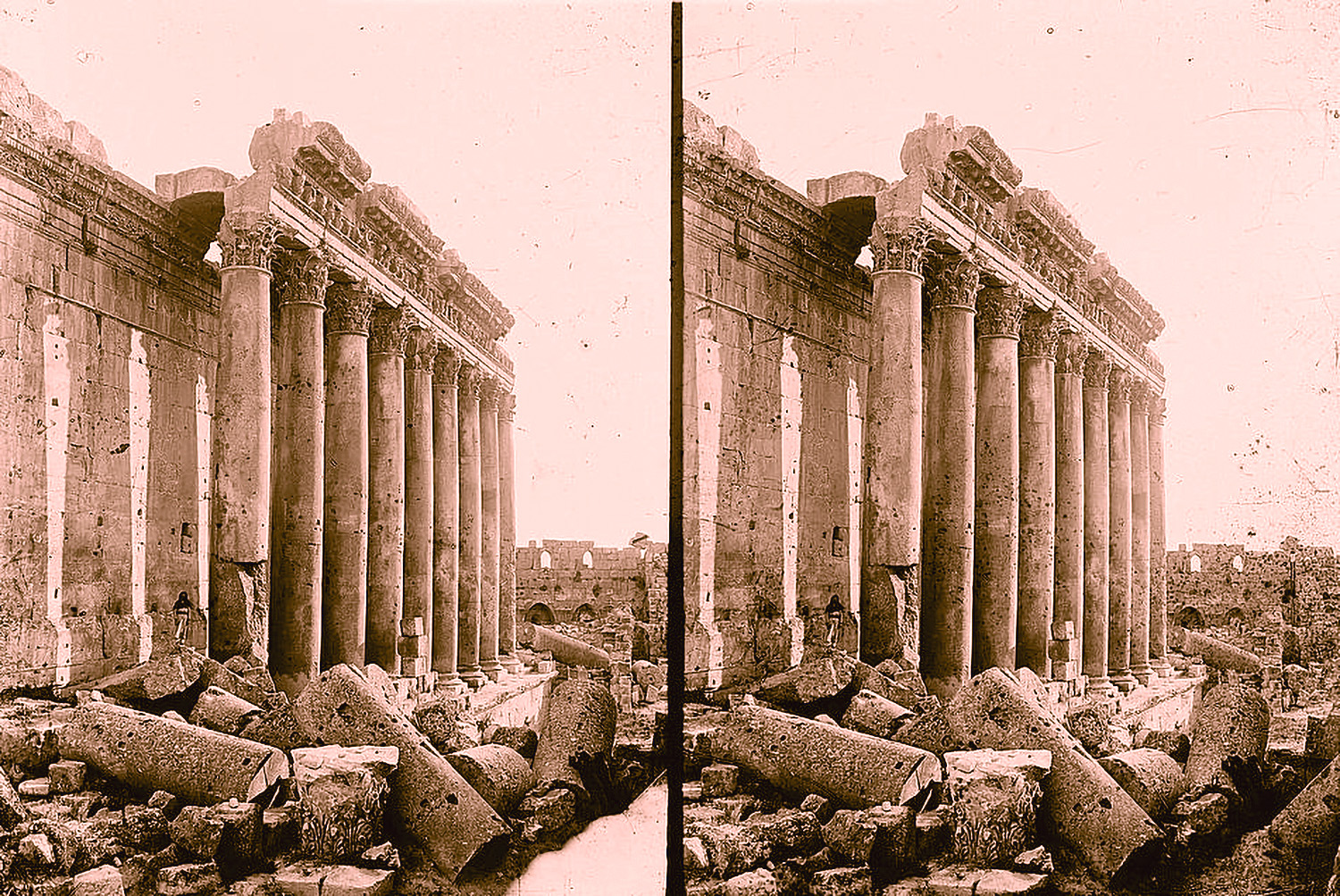
Temple of Jupiter, Baalbek, Lebanon
I imagined that the images would look quite stunning when viewed through a proper set of stereoscopic lenses – those seen in antique shops or museums. I knew that, with such a device, one would be able to view each scene in “3-D,” and that this would provide greater depth into what the original photographer had wished to convey – a new perspective into the composition. It was not strange or random at all!
I then discovered an information sheet, which had been tucked into the back of the frame. It had been printed about a century before. It stated that the images were of temple ruins situated in the ancient city of Baalbek.
It so happens that Baalbek is located in the Bekaa Valley in modern Lebanon — the home base for Hezbollah, one of Israel’s most determined adversaries. This Iranian-backed terrorist organization represents a highly aggressive force, and the Israelis and the U.S. are endeavoring to prevent its militants from fully engaging in the current conflict. The valley is situated just to the north of the Upper Galilee. In August 2006, during their incursion into Lebanon, Israeli Defense Forces raided Baalbek but did no damage to the archaeological site.
Western scholars became particularly interested in Baalbek about the time that Kaiser Wilhelm II visited the region as a tourist back in 1898. German archaeologists started excavating the site shortly thereafter. I concluded from examining other period photos of the site that the images in my stereoscopic presentation were based upon photography taken during that same time frame (circa 1900).
Now a UNESCO World Heritage Park, Baalbek was known as Heliopolis (“Sun City”) during Hellenistic and Roman periods. However, the archeological site, like most in the Levant, predates the Greco-Roman world.
One of the most important cultures to have inhabited Baalbek was the Ugaritic. Ugarites were a branch of the Phoenicians – a Greek term for the surviving Canaanites who had become well established in their kingdoms in the north, just as the Israelites were starting to get organized in the spiny hill country to the south. The ruins of the principle city of Ugarit are located near the Mediterranean coast of modern Syria.
The main take-away, at least in biblical terms, is that these Phoenician-Ugaritic “post-Canaanites” were already using a 22-letter alphabet by 1100 BC, which the Israelites would later adopt and adapt when they began writing down the first drafts of the Bible roughly around 900 BC in biblical Hebrew (or proto-Hebraic) script.
One should never dismiss faith-based convictions that postulate a much earlier date for the composition of portions of the Bible, such as the Pentateuch. Some early passages, such as the “Song of Miriam,” were passed down orally in verse. However, at this juncture there is little in the archaeological record to confirm the appearance of widespread Hebrew writing prior to the middle of the 9th Century BC. Future discoveries may push that dating back.
Nevertheless, the invention of the Alphabet was the first major “communications revolution,” and humanity would progress significantly as a result of it. More importantly, the adoption and spread of this consonant-based script would pave the way for the completion of large portions of the Hebrew Bible prior the Babylonian exile in 586 BC.
The archaeological record left by this Phoenician-Ugaritic culture provides modern scholars with other insights into the people who began writing the Bible. First, Ugaritic monuments and writings offer interesting clues about the design, construction, and function of the First Temple built by Solomon (circa 967 BC). Second, they shed light on what many scholars today believe to be the three-stage evolution of early Israelite religion from polytheism to monolatry (whereby a national god was worshipped but lesser gods were countenanced) to pure monotheism (“Hear O Israel, the Lord our God is One!”).
The placename “Baalbek” itself derives from “Ba-‘el” or Baal, the storm god of the Canaanites. Elijah, of course, would do battle in the 9th Century BC with the priests of Baal on Mount Carmel – thereby incurring the wrath of Jezebel, who besides being a Queen of the northern Kingdom of Israel, was in her own right a Phoenician princess. And of course, after her demise during Jehu’s coup, Jezebel would experience an unfortunate rendezvous with a pack of dogs after having been pushed from a window.
* * * * *
By coincidence, a weekly Bible lesson that I was reading about that same time featured the story of Jesus’s encounter with “a woman of Canaan,” who had approached him seeking the healing of her sick child. The meeting took place after the Master had “departed into the coasts of Tyre and Sidon” (meaning that he had crossed over the border of Galilee into the dominions of these two client-polities of the Roman Empire). The woman was a descendant of the much earlier Phoenician-Ugaritic people, who once flourished in Baalbek and other parts of what would become modern Lebanon.
Metaphorically alluding to the gruesome fate of the Phoenician princess Jezebel, a story that would have been well known to the Jewish audience of the writer of Matthew’s Gospel, the account describes how Jesus initially rebuffs the petition of the Canaanite woman with the words, “It is not meet to take the children’s bread, and to cast it to dogs.” (King James Bible)
Picking up on Jesus’s oblique reference to her notorious ancestor but diplomatically turning the encounter around in order to facilitate a more positive outcome, the woman boldly responds, “Truth Lord: yet the dogs eat of the crumbs which fall from their master’s table.”
Acknowledging the woman’s extraordinary faith, Jesus first handles the belief of the 1200-year-old enmity between Jews and Canaanites – that age-old struggle between the God of Israel and Baal of the Phoenicians. He does this by silently recognizing the conflict as just one more seeming struggle between the assured promise of God’s spiritual abundance versus the shackles of physical limitation that human beings often impose upon themselves. In healing this complex challenge, the Master teaches his followers the necessity of casting aside “first impressions” — no matter how entrenched they seem to be.
Jesus then closes this important episode in his ministry by assenting to the woman’s earnest petition, and he restores her daughter to complete health.
* * * * *
Both major conflicts today – the war in Ukraine and the crisis in the Middle East – need our outstretched hands filled with crumbs of comfort, our willingness to recognize others as the beloved children of God, and our continued prayers for a speedy return to peace.
In light of the recent news from Israel, the story of the healing of the Canaanite woman’s precious child – and of the First-Century conflict between Jews and an ancient people who present-day Palestinians consider to be their forebears – remains a poignant reminder of what is possible when the Christ (or Messiah) is invited to the feast. Much like observing two slightly different images of the same scene through a stereoscopic viewer, we soon discover a perspective that we otherwise would have missed.
 Bruce Slawter.com
This is a deeply thoughtful and penetrating piece. May all those who read it find hope and prayerful inspiration, as I did. Thank you, Bruce Slawter. You gave the world a gift with this post.